





Whether you’re reviewing an infrared survey report or just want to understand the technology behind it, this glossary breaks down the technical terms and instrumentation vocabulary used throughout the infrared thermography testing industry — from emissivity and NETD to blackbody radiation and thermal drift. Use it as a quick reference, or contact ICS’s certified thermographers if you have questions about your own survey results.
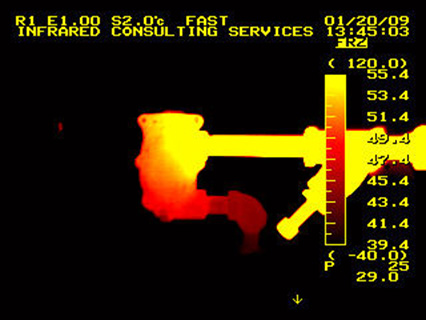
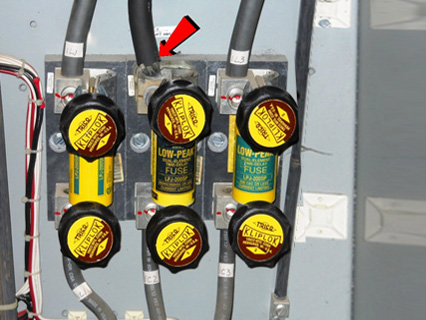
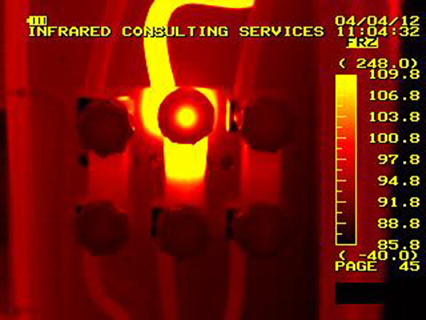
See how infrared testing helps catch electrical problems early.
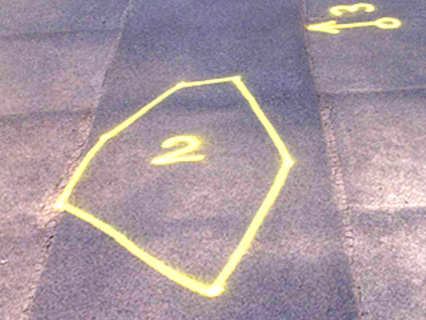
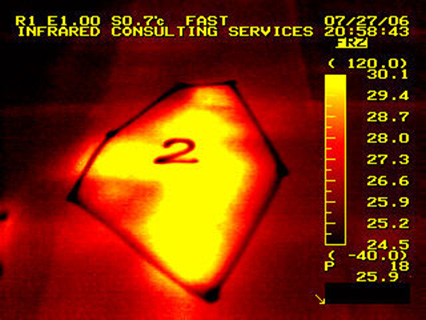
Find out how infrared surveys locate trapped roof moisture.
Learn how infrared evaluation documents roofing system condition.
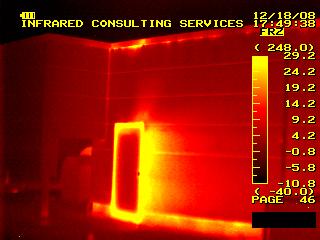
See how infrared testing evaluates building envelope performance.
Learn how infrared testing detects wall moisture.
Find out how baseline infrared surveys work.
Learn how infrared testing applies to high voltage environments.
See how infrared testing inspects mechanical machinery.
Learn how infrared testing is used on steam utilities.
Find out how infrared testing applies to boilers and refractories.
Infrared Thermography Glossary
A B C D E F G I J K L M N O R S T V W
Absolute Zero
The lowest possible temperature: -273.16°C, -459.69°F, or 0 Kelvin — the point at which molecular motion theoretically stops and a body holds no thermal energy.
Accuracy
How closely a radiation thermometer’s reading matches the true, known temperature of a reference source. Accuracy can be expressed in degrees, as a percentage of the reading, or as a percentage of the instrument’s full measurement scale.
Ambient Derating
A drop in an instrument’s accuracy caused by ambient temperature shifting away from the conditions it was calibrated under. See Temperature Coefficient.
Ambient Operating Range
The span of ambient temperatures an instrument is designed to function within.
Ambient Temperature
The surrounding temperature around the instrument itself — sometimes also used to describe the temperature giving rise to background radiation. See Background Radiation.
Ambient Temperature Compensation (TAMB)
See Reflected Energy Compensation.
ASTM
The American Society for Testing and Materials, the industry body behind many of the standards infrared testing equipment is measured against.
ASTM E 1256
ASTM E1256-88, the standard test method for single-waveband radiation thermometers, covering accuracy, repeatability, resolution, target size, response time, warm-up time, and long-term drift.
Atmospheric Windows
The wavelength bands where the atmosphere interferes least with radiant energy transmission — roughly 0.4–1.8, 2–2.5, 3–5, and 8–14 micrometers.
B
Background Radiation
Radiant energy reaching an instrument from something other than the actual target — often from reflections off the target itself or scattering inside the device.
Blackbody
A theoretical perfect radiator that absorbs all radiation striking it; its emissions are described by Planck’s Radiation Law.
C
Calibration Procedure
The process used to check and adjust an instrument so it performs within its specified limits.
Carnot Cycle
An idealized heat engine cycle representing the most efficient possible conversion of thermal energy into mechanical work.
Celsius or C
The temperature scale where TC = TK − 273.15. Water freezes at roughly 0°C and boils at roughly 100°C at standard atmospheric pressure. Formerly known as the centigrade scale.
Color Temperature
The temperature of a blackbody whose radiant energy has the same spectral distribution as the light coming from a given surface.
Colored Body or Non Gray Body
A radiating source whose emissivity changes depending on wavelength, rather than staying constant.
Comparison Pyrometry
A method of determining an unknown target’s temperature by adjusting a calibrated reference source until it radiates the same amount of energy as the target.
Current-Loop
A communication method that transmits signal as electrical current over a pair of wires, commonly using a 4–20 mA range to represent minimum and maximum signal levels. Some digital applications instead use different current magnitudes to represent a logical 1 and 0. Current loops are typically limited by the maximum impedance of whatever device is connected to them.
D
D:S
Optical resolution written as a ratio — the distance to a target divided by the diameter of the measurement spot at that distance.
Deadband
A temperature range around a set point where an alarm or relay won’t change state, which builds in hysteresis.
Detector
The component that converts incoming electromagnetic energy into a proportional voltage or current signal. See Thermopile, MCT, Thermoelectric Cooled, Pyroelectric, Lead Selenide, and Silicon detectors.
Dielectric Withstand (Breakdown Voltage)
The highest voltage an electrical insulator can handle before current begins to conduct through it.
Digital Data Bus
Two or more electrical conductors linking multiple transmitters and receivers of digital data.
Digital Image Processing
Converting a thermal image into digital form and adjusting it — through temperature scaling, spot measurements, thermal profiles, addition, subtraction, averaging, filtering, or storage — to make it easier to analyze.
Digital Output Interval (DOI)
The time gap between transmissions of digital data packets carrying temperature and system status information.
DIN (Deutsches Institut)
The German national standards body, whose specifications cover a wide range of instrumentation products.
Drift
A change in an instrument’s reading over time that isn’t caused by any external influence on the device.
E
EMI/RFI
Electro-Magnetic Interference / Radio Frequency Interference — outside interference that can degrade electronic equipment’s performance.
Emissivity
At a given wavelength, the ratio between the infrared energy an object radiates and what a blackbody at the same temperature would radiate. A blackbody’s emissivity equals 1 at every wavelength.
Environmental Rating
A rating, typically assigned by a standards body, describing how harsh an environment a unit can reliably operate in.
External Reset (Trigger)
Returning an instrument to its power-up state — including signal conditioning features like Peak Hold, Valley Hold, Sample Hold, and Average — via an external reset input.
F
Fahrenheit or F
A temperature scale where water freezes at 32°F and boils at 212°F at standard pressure. Convert from Celsius with F = (C × 1.8) + 32.
Fail-safe Operation
A design feature that causes an instrument to default to a safe state — such as triggering an alarm or shutting down — if it loses power or otherwise fails, rather than failing silently or unpredictably.
Far Field
A measurement distance far enough from the target (typically more than 10 times the focal distance) that an instrument’s spot size grows proportionally with distance while its field of view stays constant.
Field of View (FOV)
The area or angle an optical or infrared instrument can see, usually described as a spot diameter at a given distance, or as an angular measurement at the focal point. See Optical or Infrared Resolution.
Focal Point or Distance
The distance from the instrument at which a target comes into sharpest focus on the detector — the point where resolution is at its best.
Full Scale Accuracy
Measurement accuracy expressed as a percentage of an instrument’s maximum possible reading.
G
Gray Body
A radiating source with emissivity that’s constant — but less than 1 — regardless of wavelength.
I
IEC (International Electrotechnical Commission)
A European standards body that coordinates technical standards across the European Community.
IEEE-488
A digital interface standard for programmable instruments, originally developed by Hewlett-Packard (hence its other names, HPIB and GPIB) and later adopted by the IEEE. It uses a 16-bit bus to link up to 15 instruments; the current standard is ANSI/IEEE-488.1-1987.
IFOV (Instantaneous Field of View)
The angular resolution of an imaging instrument, set by detector and lens size. For single-point instruments, IFOV and FOV are the same thing.
Image Processing
See Digital Image Processing.
Indium Antimonide (InSb)
A photon-detector material sensitive across the 2.0–5.5 µm range, used in infrared scanners and imagers. Requires cryogenic cooling.
Infrared or Optical Filter
See Spectral Filter or Neutral Density Filter.
Infrared Radiation (IR)
The portion of the electromagnetic spectrum spanning roughly 0.75 to 1,000 µm.
Infrared Thermometer
An instrument that determines an object’s temperature by detecting and measuring the infrared radiation it emits. Common types include total power, wide-band, narrow-band, and multi-wavelength.
Insulation Resistance
A material’s ability to resist electrical current flow, measured in megohms as applied voltage divided by resulting current.
Interchangeability
The ability to swap one sensor head for another of the same type without recalibrating the whole system — sometimes called Universal Electronics.
Intrinsically Safe
A safety standard limiting an instrument’s available electrical energy so it can’t ignite an explosive atmosphere during normal operation.
IP Designation
A two-digit rating (per British Standard 4752) describing an enclosure’s protection level — the first digit for accessibility, the second for environmental protection.
Isolated Inputs, Outputs & Power Supplies
Inputs, outputs, and power lines that are electrically insulated from one another, so grounding one doesn’t create ground loops or affect the others.
Isotherm
A line on a surface or chart connecting points that share the same temperature.
J
JIS (Japanese Industrial Standard)
Japan’s technical standards body, which sets accuracy benchmarks for infrared thermometers among other instruments.
K
Kelvin or K
An absolute temperature scale tied directly to a body’s heat energy, where 0 K represents no thermal energy. Water’s triple point is defined as 273.16 K. Convert from Celsius with K = C + 273.16.
L
Lead Selenide (PbSe)
A photon-detector material sensitive in the 3–5 µm band, used in IR thermometers, scanners, and imagers. Requires thermoelectric cooling.
M
Maximum Current
The largest electrical load an instrument’s mA output can drive — for example, a 500-ohm maximum loop impedance means the instrument can supply 10 volts at 20 mA into that load.
MCT (Mercury Cadmium Telluride) or HgCdTe
A detector alloy sensitive in the 3–5 µm and 8–14 µm bands, requiring thermoelectric cooling for the shorter band and cryogenic cooling for the longer one.
Minimum Spot Size
The smallest target diameter an instrument can measure while still meeting its stated performance specs.
N
NEMA
The National Electrical Manufacturer’s Association — a US standards body that, among other things, sets housing enclosure ratings comparable to the IEC’s IP system.
NET
See NETD.
NETD (or NE∆T)
Noise Equivalent Temperature Difference — the smallest temperature change in a target that produces a change in an instrument’s signal equal to its own background electrical noise. Essentially, the smallest real difference the instrument can distinguish from its own noise.
Neutral Density Filter
An optical or infrared filter whose transmission stays constant regardless of wavelength.
NIST Traceability
Calibration performed against standards traceable to the National Institute of Standards and Technology (NIST), which keeps reference standards valid and current.
O
Optical or Infrared Resolution
The ratio of distance-to-target versus the diameter of the measurement spot, defined as the point where the instrument collects a set percentage (typically 90–95%) of the energy a calibration source at the same temperature would produce.
Optical Pyrometer
A device that determines an unknown source’s temperature by visually comparing it to a standardized reference light source.
Output Impedance
The impedance a thermometer presents to whatever it’s connected to. For accurate readings, the connected device’s input impedance needs to be much higher than the thermometer’s output impedance.
R
Radiance Temperature
The temperature of a blackbody whose radiance, at a given wavelength or band, matches the radiance of the actual target.
Radiant Energy
Electromagnetic energy an object emits purely because of its temperature.
Radiation Thermometer
A device that measures an object’s temperature by quantifying the electromagnetic radiation it emits — essentially a radiometer calibrated to read blackbody temperature.
Rankine or R
An absolute temperature scale related to Fahrenheit the way Kelvin relates to Celsius: R = 1.8 × K, or R = F + 459.67.
Reference Junction or Cold Junction
The thermocouple junction whose temperature must be known to determine the temperature at the actual measurement junction.
Reflectance
The ratio of radiant energy reflected off a surface to the energy that hit it in the first place.
Reflected Energy Compensation
A correction that improves accuracy by accounting for background infrared energy reflecting off the target into the instrument, provided the background temperature is known.
Relative Humidity
The ratio of the air’s actual water vapor pressure to its saturation vapor pressure (RH), usually expressed as a percentage — an RH of 0.30 is reported as 30%.
Repeatability
How consistently a single instrument reads the same object under the same conditions across repeated measurements. ASTM E1256 defines it as the sample standard deviation across twelve readings at the center of the instrument’s range.
Resolution
See Temperature Resolution, Optical Resolution, or Spatial Resolution.
Response Time
The time it takes an instrument’s output to reach 95% of its final value after an instantaneous jump to the maximum temperature it can measure, per ASTM E1256. For some instruments this also includes internal processing time.
RS-232
A serial communications standard (current revision EIA-RS-232-D) governing the interface between data terminal equipment and data communications equipment. It defines electrical characteristics, connector mechanics, and interface functions, but not the data protocol itself — internationally equivalent to CCITT V.24.
RS-422
A balanced-interface standard building on RS-423, extending data rates up to 10 Mbps.
RS-423
An unbalanced-interface standard extending RS-232 with longer cable runs, higher data rates, and support for multiple receivers on one line.
RS-485
A refinement of RS-422 that allows more receivers and transmitters on the same line.
RTD (Resistance Temperature Device)
A contact temperature sensor whose electrical resistance changes predictably with temperature.
S
Sample Hold
A single temperature reading captured from a target and held on the display until the next reset.
Scatter
Background radiation that reaches a detector after bouncing around inside or around the instrument, rather than reflecting directly off the target.
Set Point
A threshold value that, once crossed, triggers an event such as an alarm or a relay change.
Shock Test
An impact test that subjects a unit to a sudden force strong enough to excite its mechanical resonances.
Signal Processing
Techniques applied to temperature data to make it more useful — Peak Hold, Valley Hold, and Averaging are common examples.
Silicon (Si) Detector
A photon detector used for measuring high temperatures.
Size-of-Source Effect
The tendency for an instrument’s reading to keep climbing as a target grows larger than the instrument’s field of view — caused by residual energy outside the defined measurement percentage plus scattered radiation entering from outside the FOV. This means very large and very small targets can both affect accuracy. Also called Target Size Effect. [ASTM STP 895]
Slope
In a two-color radiometer, the ratio between the emissivity of the shorter-wavelength band and the emissivity of the longer-wavelength band — used to account for materials whose emissivity shifts with wavelength.
Spectral Filter
An optical or infrared component that limits which wavelengths of radiant energy reach the detector.
Spectral Response
The specific wavelength range an infrared thermometer is sensitive to.
Spot
The diameter of the area on a target where a temperature reading is actually taken — defined by the aperture that captures roughly 90% of the target’s IR energy. See Size-of-Source Effect.
Stare or Lag
A saturation effect where an instrument’s signal lingers past its normal response time after the target is removed — often from extended exposure to a high-temperature target. Measured as the extra time needed to return within 5% of the correct reading.
Storage Temperature Range
The ambient temperature range an instrument can survive while not operating, and still perform to spec once it’s turned back on.
T
Target
The object a temperature reading is being taken from.
Target Size Effect
See Size-of-Source Effect.
Teflon®
A registered trademark of DuPont.
Temperature
A property of an object that determines the direction heat flows when it’s placed in contact with another object — from the hotter region to the cooler one.
Temperature Coefficient
How much an instrument’s accuracy shifts with changes in ambient temperature from its original calibration conditions, usually stated as a percentage (or degree) of error per degree of ambient change. For sudden ambient shifts, see Thermal Shock.
Temperature Resolution
The smallest change in target temperature that produces a usable, detectable change in an instrument’s output or display.
Temporal Drift
See Temperature Coefficient.
Thermal Detector
A detector that converts incoming radiation into heat first, then into a signal — includes pyroelectric, bolometer, and thermopile types.
Thermal Drift
See Temperature Coefficient.
Thermal Radiator
Any object that emits electromagnetic energy because of its own temperature.
Thermal Shock
Measurement error caused by a rapid ambient temperature change, expressed as a maximum error plus the recovery time needed to return to spec.
Thermistor
A semiconductor whose electrical resistance changes with temperature.
Thermocouple
A pair of junctions made from two dissimilar metals, used to measure temperature via the Peltier effect — a small voltage develops between the junctions in proportion to their temperature difference. Common types include:
J (Fe / constantan) K (chromel / alumel)
T (Cu / constantan) E (chromel / constantan)
R (Pt / Pt – 30% Rh) S (Pt / Pt -10% Rh)
B (Pt – 6% Rh / Pt – 30% Rh) G (W / W – 26% Re)
C (W – 5% Re / W – 26% Re) D (W – 3% Re / W – 25% Re)
Thermoelectric (TE) Cooling
Cooling based on the Peltier effect: running current through a junction of two dissimilar metals makes one side grow hot and the other cold. The hot side dissipates heat to the environment while the cold side does the cooling.
Thermogram
A thermal image produced by scanning an object or scene.
Thermopile
A series of thermocouples wired together so alternating junctions sit at a reference temperature and a measurement temperature, boosting the signal for a given temperature difference.
Time Constant
The time a sensor takes to reach 63.2% of its final reading after a sudden change at the target.
Transfer Standard
A precision radiometric instrument, calibrated traceably to NIST (or an equivalent national standard elsewhere), used to calibrate other radiation reference sources.
Transmittance
The ratio of infrared energy that exits an object to the energy that entered it.
Triple Point
The specific temperature and pressure at which a substance’s solid, liquid, and gas phases can all coexist in equilibrium — for water at atmospheric pressure, this is essentially its freezing point.
Two-Color Thermometry
A technique measuring energy in two separate wavelength bands to determine temperature, useful for correcting errors from partial target obstruction like dust.
V
Valley Hold
The minimum temperature recorded by an instrument during the period this display mode is active.
Verification
Confirming that a design meets all of its specified performance requirements.
Vibration Test
A test (per MIL-STD-810 or IEC 68-2-6) that subjects a unit to repetitive motion at specified acceleration and power spectral density levels, then checks for continued proper operation.
W
Warm-Up Time
How long an instrument needs after power-on before it performs within its stated repeatability.
Have questions about a term in your infrared survey report, or want to talk through what your results mean? Contact ICS — we’re happy to walk through it with you. We serve customers nationwide.
 By detecting problems before they occur and by pin-pointing exactly where problems might exist, Infrared Thermographic Testing has many benefits.
 Learn more about our wide range of non-invasive, non-destructive inspection & testing services and if they are right for your needs.
 Founded in 1988, Infrared Consulting Services (ICS) provides professional infrared electrical, NDT and building envelope inspection services nationwide.